I recently wrote a post in which my analysis showed that The same ancestors which provided iranian like ancestry to Irula tribals also provided ancestry to Steppe Eneolithic as well as South Central Asia (Sarazm aDna etc). One can read the post here.
For feedback as well as spreading the post, I posted the link to a popular DNA & population genomics forum - Anthrogenica. Quite unexpectedly, immediately after, I was suspended from Anthrogenica with no reason or message whatsoever. I always knew it is a Kurganist bastion, but never quite expected this level of censorship to opposing ideas. I am glad though, starting this blog is now worth it. Also, credit to Davidski at Eurogenes blog for allowing me on his blog comments section even with my opposing views.
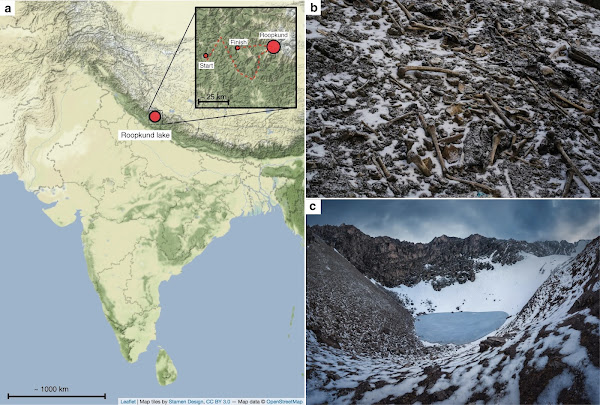
I came to know that the Moderator who banned me is a handle named Coldmountains, a handle who I have in the past ridiculed quite a lot (in Eurogenes comment section) for not finding a single R-L657 indian y haplogroup in the steppe since 2015. Poor guy comes empty handed after each successive paper when new samples from the steppe are published. His search still goes on. Meanwhile the only L657+ sample we have so far in aDna is from Roopkund lake India 800CE.
The link to my Anthrogenica thread is here. Please register and show Anthrogenica some love in this thread and elsewhere. The moderator clique there is in an echochamber and needs some awakening.
Anyway, let move on to the criticism of my post. There is just one, and sadly i couldn't reply because I was banned. Hence this post.
Kale on 25-Nov-2021 wrote
Kotias is a pseudo-haploid sample > That means rather than having two different sets of chromosomes like a real person, it is treated as having two exactly identical sets > That means the drift going to itself it going to be crazy high > If you have an edge coming out of an artificially crazy high drift, the percentage contribution has to be artificially crazy small to avoid overfitting.
This graph is completely uninformative until structured properly.
Kale is absolutely wrong here. The pseudo-haploid* samples do not cause artificial high drift edges, rather, the artificially high drift is due to just 1 sample in the label because of which heterozygosity cannot be computed for the label. This problem is solved by using 2 samples in the label even if samples are pseudo-haploid. This is not a problem for .DG samples as these are diploid genomes and allow for heterozygous calls.
This is exactly what I have done in the graph below (later). I lumped Satsurblia & Kotias into 1 label known as CHG. I will show that my conclusion does not change.
Proof of my claim is from the programmers of Admixtools in their qpGraph readme pasted below. Should have been basic reading right?
Genotypes are expected to be pseudo-haploid -- 2 samples at least per population or drift lengths on leaves are not meaningful.
As far as edges coming out of artificially high drifts are concerned, sister clades of Kotias also did not help Kales case. See, i spent weeks on the model trying every possibility. Them not being able to read the graph is not my problem.
Below I will paste my new qpGraph for Steppe Eneolithic which follows these principles and should be acceptable to the Kurganists as well.
- Worst residual ZScore below 3.
- CHG label now has 2 samples and therefore allows for heterozygous calls.
- Each admixture node has a drift edge following it rather than an immediate admixture edge. 1 or 2 admixture edges in my graph follow an immediate admixture node because the drift edge length was 0 (hence i omitted them)
- Non 0 drift edges implying that the edge is a true one. (This is not a strict need. qpGraph disallows immediate admixture edge if the admixed node is labeled as a number. But qpGraph allows the admixture node to be a source to another node if the label given to it is alphanumeric. This is useful if multiple admixtures together are to be modeled.)
Please click on the graph for high res mobile view. On Desktop download image and zoom in a zoomable picture viewer.
DISCUSSION
After correcting all criticisms, the need for IndiaN component in Steppe eneolithic does not go away. I again prove that the same ancestors who ultimately provided ancestry to Steppe Eneolithic in 5th mil BCE also provided ancestry to Irula tribe (and by extension most of indian groups). The minute criticisms which Kurganists come up with are immaterial now, because of course they will come up with them. So far, they have been busy denying even Iranian inflow into steppe (its a mater of purity of course!), so to accept South/ SC Asian origin is a different matter altogether.
I conclude that Steppe_En is
60% EHG + 12% CHG + 22% IndiaN related + 6% IranN related +- std errors
As I stated in my previous post:
Where this IndiaN source lived in 6th millenium bce is unknown yet, but in the vicinity of NW south asia and SC asia will be a good guess. Could be either early Mehrgarh culture or Jeitun culture but we need ancient samples from these cultures.
*pseudo-haploid genome = randomly sampling 1 allele from a biallelic SNP (Single Nucleotide polymorphism) marker.
Diploid genome = sampling both alleles of the biallelic SNP
Heterozygosity = measure of genetic variability in a population (cannot be computed with single haploid genome)