Showing posts with label sintashta. Show all posts

Monday, November 28, 2022

Mitanni at Hasanlu - Did they have Sintashta ancestry or not?

I want to make a quick post on a new article by Nezih Seven. You can find it here.

A Genetic Analysis of Historical Population Movements Around The Zagros Mountains


He analyzed the NW Iranian samples from the 'Southern Arc' paper and reached some interesting conclusions.
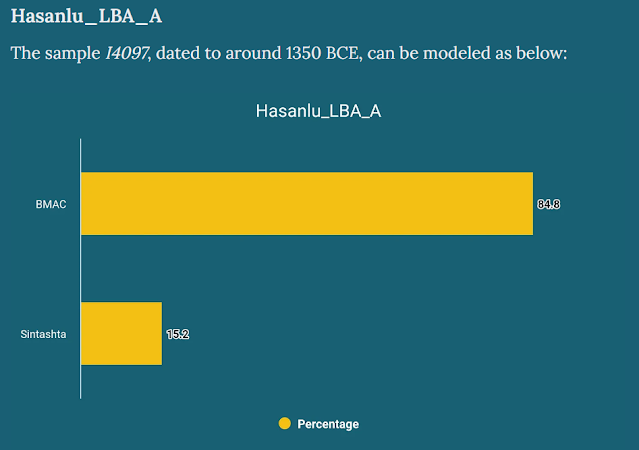
Nezih model hasanlu_lba 85% bmac + 15% sintashta
Model for Hasanlu_LBA_A by Nezih


The p-value of the above model is ~0.20 (therefore passing as p>0.05). His qpAdm output file can be seen here

Friday, August 26, 2022

The Southern Arc paper and it's data upends the Steppe Theory in multiple ways


Hasanlu Indra chariot


Lazaridis, Iosif, et al. “The Genetic History of the Southern Arc: A Bridge between West Asia and Europe.” Science, vol. 377, no. 6609, 2022, https://doi.org/10.1126/science.abm4247.


This is a recently published paper ('the paper', 'this paper') with many new samples from what the authors call 'The Southern Arc'. The authors define it as 'a region centred on the large Anatolian peninsula (Turkey), including in the west (in Europe) the Balkans and the Aegean, and in the south and east, Cyprus, Mesopotamia, the Levant, Armenia, Azerbaijan, and Iran.'

The main conclusion of this paper which upends one part of the Steppe theory is that West Asia is now considered to be the homeland of the first Indo-European speakers, and the steppe to be only a secondary homeland. From the paper:

Sunday, August 14, 2022

Update: IVC & Swat Valley Genetics, Bonus - Kashmiri Pandit Ancestry

SECTION A: THE INDUS PERIPHERY SAMPLES


In the Narasimhan et al 2019 paper, 13 outlier samples were published - 10 from the Iranian site of Shahr-i-Sokhta (abbrv. SiS, various dates 3100-2000 BCE) and 3 from the Bactria Margiana Archaeological Complex (abbrv. BMAC) site of Gonur (2400-2000 BCE). These samples showed an elevated ancestry component found in the Onge Andamanese and modern Indians, which was not found in the main samples from SiS and BMAC. Based on this, the hypothesis was made that these people were migrants from one or more sites of the Indus Valley Civilization (abbrv. IVC) and were labeled as 'Indus Periphery Samples'.

Various Site Locations


Thursday, December 30, 2021

Steppe ancestry entered modern Indian Populations post 900 BCE

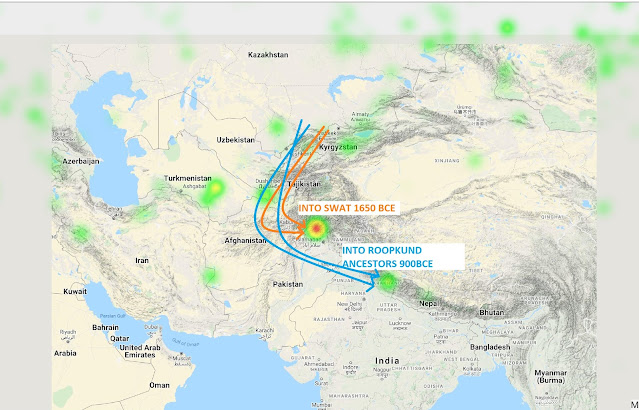
Steppe movement into Indian subcontinent - 1650BCE and 900BCE


In this post, I analyze the date of steppe admixture with local ancestry in Swat Valley Iron age samples (avg 910 BCE) and RoopkundA (avg 850 CE) samples from Uttarakhand, India. These are the only 2 sets of good quality ancient DNA samples from the Indian subcontinent, and therefore extremely important to study the genetic changes in the subcontinent. 

 In one of my earlier posts, I analyzed all 23 RoopkundA samples and show that in that set of 13 male samples, the steppe component is not correlated with Y-HG R1a1a, instead, it is correlated with Y-hg J2. 

Tuesday, December 14, 2021

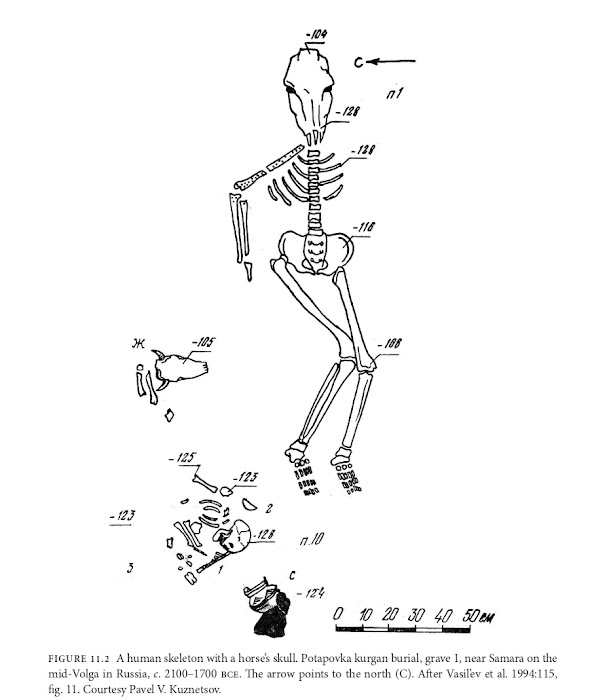
David Anthony, Michael Witzel, Asko Parpola & the Potapovka horse head burial HOAX


In 1995, a paper1 was published by David Anthony, the well known kurganist, and Prof  Nikolai Vinogradov titled 'Birth of the Chariot'. The paper mainly sought to explain the findings at the Potapovka & Sintashta-Petrovka sites in Russian steppe and relate them to Vedic rituals. Before we get to the crux of this article, I first want to deal with 2 other claims made in the same 1995 paper. First one is: