Wednesday, August 31, 2022

Armenia vs NW Iran - Two different short stories

 The Armenian Data from the new papers


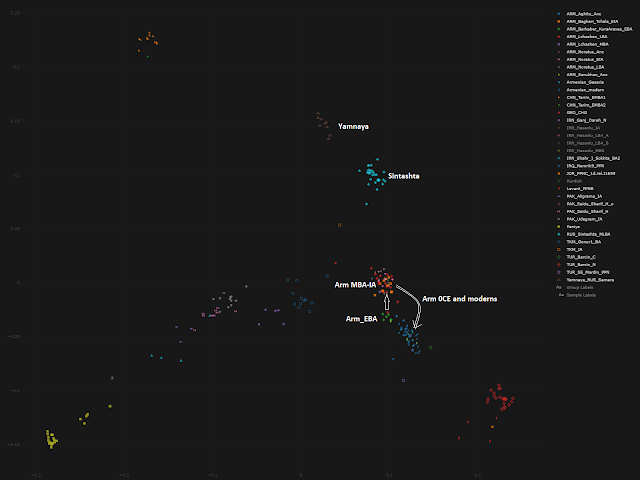
1. Some EHG ancestry from north of caucasus is seen at Areni Cave, 4200BCE.

2. EHG dilutes by the time of Kura Araxes 3600-2000BCE, Arm_EBA (green below).

3. Arm_MBA/LBA/IA cluster clearly shifts towards steppe, with lots of R1b & I2 Y hg. According to Lazaridis et al, this explains the Armenian language branch. For now I will accept this conclusion as it makes sense, and explains the different language of NW Iran.

4. Post IA, intense mixing with more southwestern populations (but not NW Iran) so much so that all steppe autosomal ancestry gets diluted.


Armenia PCA
PCA - Ancient & Modern Armenia

Friday, August 26, 2022

The Southern Arc paper and it's data upends the Steppe Theory in multiple ways


Hasanlu Indra chariot


Lazaridis, Iosif, et al. “The Genetic History of the Southern Arc: A Bridge between West Asia and Europe.” Science, vol. 377, no. 6609, 2022, https://doi.org/10.1126/science.abm4247.


This is a recently published paper ('the paper', 'this paper') with many new samples from what the authors call 'The Southern Arc'. The authors define it as 'a region centred on the large Anatolian peninsula (Turkey), including in the west (in Europe) the Balkans and the Aegean, and in the south and east, Cyprus, Mesopotamia, the Levant, Armenia, Azerbaijan, and Iran.'

The main conclusion of this paper which upends one part of the Steppe theory is that West Asia is now considered to be the homeland of the first Indo-European speakers, and the steppe to be only a secondary homeland. From the paper:

Thursday, August 18, 2022

A Relook at the Rakhigarhi ancestor I6113


In my previous post, I analyzed the so-called 'Indus Periphery' samples from the data published in Narasimhan et al 2019. 

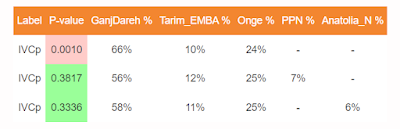
My conclusion was that the IVCp samples can be best modeled distally as 

Ganj_Dareh + Ancient North Eurasian (Tarim_Basin or West Siberian HG) + Onge + Levant_PPN or Anatolian Farmer.

IVC periphery models

In this post, I shall do an in depth analysis of the genome of the lone Rakhigarhi sample (Id: I6113, female) dated to around 2000 BCE, published in Shinde et al 2019. 

Burial picture of Rakhigarhi woman I6113
Picture of I6113 burial, Rakhigarhi. From Shinde et al 2019


Sunday, August 14, 2022

Update: IVC & Swat Valley Genetics, Bonus - Kashmiri Pandit Ancestry

SECTION A: THE INDUS PERIPHERY SAMPLES


In the Narasimhan et al 2019 paper, 13 outlier samples were published - 10 from the Iranian site of Shahr-i-Sokhta (abbrv. SiS, various dates 3100-2000 BCE) and 3 from the Bactria Margiana Archaeological Complex (abbrv. BMAC) site of Gonur (2400-2000 BCE). These samples showed an elevated ancestry component found in the Onge Andamanese and modern Indians, which was not found in the main samples from SiS and BMAC. Based on this, the hypothesis was made that these people were migrants from one or more sites of the Indus Valley Civilization (abbrv. IVC) and were labeled as 'Indus Periphery Samples'.

Various Site Locations


Sunday, June 19, 2022

Marija Gimbutas's Kurgan Hypothesis rejected by Harvard


The Genetic History of the Southern Arc: A Bridge between West Asia & Europe

Below are some excerpts from the notes of a talk which will be delivered by Dr David Reich at an Israeli university in July 2022.

Our comprehensive sampling shows that Anatolia received hardly any genetic input from Europe or the Eurasian steppe from the Chalcolithic to the Iron Age; this contrasts with Southeastern Europe and Armenia that were impacted by major gene flow from Yamnaya steppe pastoralists.

The impermeability of Anatolia to exogenous migration contrasts with our finding that the Yamnaya had two distinct gene flows, both from West Asia, suggesting that the Indo-Anatolian language family originated in the eastern wing of the Southern Arc and that the steppe served only as a secondary staging area of Indo-European language dispersal. 

Here, Dr Reich confirms what I have already said before - That the Anatolian branch of the IE language family has its origin in Armenia and has nothing to do with Steppes. I believe this is the first time that Harvard will officially debar Steppefrom being a PIE homeland contender. 

Read my post - The Armenian Origin of the Anatolian branch of IE language family

Friday, May 6, 2022

New 7300 year old samples from the Middle Don region in Europe & the oldest sample yet from SC Asia


New Preprint: 

Population Genomics of Stone Age Eurasia. bioRxiv. Published online 2022. doi:10.1101/2022.05.04.490594


They found some new cool samples from 5300 bce. These are samples from Middle Don region with CHG ancestry. These should be the ancestors of the Khvalynsk samples who show no IranN/IndiaN as per my modeling. 

From the preprint:


Interestingly, two herein reported ~7,300-year-old imputed genomes from the Middle Don River region in the Pontic-Caspian steppe (Golubaya Krinitsa, NEO113 & NEO212) derive ~20-30% of their ancestry from a source cluster of hunter-gatherers from the Caucasus (Caucasus_13000BP_10000BP) (Fig. 3). Additional lower coverage (non imputed) genomes from the same site project in the same PCA space (Fig. 1D), shifted away from the European hunter-gatherer cline towards Iran and the Caucasus. Our results thus document genetic contact between populations from the Caucasus and the Steppe region as early as 7,300 years ago, providing documentation of continuous admixture prior to the advent of later nomadic Steppe cultures, in contrast to recent hypotheses, and also further to the west than previously reported.

We demonstrate that this “steppe” ancestry (Steppe_5000BP_4300BP) can be modelled as a mixture of ~65% ancestry related to herein reported hunter-gatherer genomes from the Middle Don River region (MiddleDon_7500BP) and ~35% ancestry related to hunter-gatherers from Caucasus (Caucasus_13000BP_10000BP) (Extended Data Fig. 4). Thus, Middle Don hunter-gatherers, who already carry ancestry related to Caucasus hunter-gatherers (Fig. 2), serve as a hitherto unknown proximal source for the majority ancestry contribution into Yamnaya genomes.


Now this 35% CHG/IranN which came in later, this should contain the IndiaN/IranN that I have written about at length in previous posts. 

Let me get my hands on the geno files, I should have a lot of fun working with these samples.

UPDATE:

The paper has 3 new samples from the neolithic Western Iranian site of Tepe Guran dated to around 7000BCE. Should be similar to the Ganj Dareh samples. The male sample is J2a.

Most importantly, they have a 4600 BCE sample from the south Turkmenistan site of  Monjukli-Depe.

Y-HG is L1a. The paper says this

"The Neolithic individual from Turkmenistan (~6,500 BP) clusters close to Neolithic Iranians."

So I think we will finally have a sample with the IndiaN ancestry rather than IranN. IranN is the western version, IndiaN being the eastern one. This ancestry gets diluted due to later influx from West Asia as seen in the later AnatoliaN heavy Geoksyur, Anau and Namazga samples.


Sunday, April 10, 2022

New ancient samples from Xinjiang may be a source for modern Ror and Burusho people

Kumar V, Wang W, Zhang J, et al. Bronze and Iron Age population movements underlie Xinjiang population history. Science. 2022;376(6588):62-69. doi:10.1126/science.abk1534

New mammoth paper containing 201 ancient samples from Xinjiang got published recently. Although I do not have access to the main paper yet, I did go through the supplement file and excel data which has most of the technical information about the samples. 

An in depth analysis of all the samples is out of the scope of this post, I will just leave a few generic thoughts about them here.

1. Early bronze age samples (pre 2000 Bce) have ancestry from Afanasievo, Tarim Basin and minor BMAC.

2. Late bronze age samples between 1500-1000 Bce are mostly similar to Sintashta_MLBA with minor addition of other ancestries.

3. For Iron age samples, in general they lie on a cline between Sintashta/Andronovo and east asian ancestry from Mongolia Slab grave culture. With some samples closer to Andronovo/Sintashta and other samples heavy on the east Asian ancestry.

4. All these Iron Age samples have additional ancestry from either BMAC, Afanasievo, Tarim Basin or Swat (SPGT), or all of them. In short, the samples are all over the place. 

5. None of the samples are confirmed archaeologically to be Tocharian speakers, so in my mind all 3 external ancestries - Afanasievo, Andronovo & BMAC could be a source for Tocharian. I prefer Andronovo as the Tocharian source, with BMAC ancestry providing Bactrian & Sogdian loanwords to Tocharian, but that's just a hypothesis.

6. The SPGT like ancestry from the Indian subcontinent almost definitely provided the Sanskrit loanwords, Buddhist culture and Brahmi script to Xinjiang in the iron age.

7. Bronze age male samples are mostly R1b+, possibly related to Afanasievo, with few Q1+ samples. 

8. 3 males samples from the LBA, 1 is R1a-Z2124+ (from andronovo), another is supposedly R1a-Z280+ (European) and 3rd one belongs to Q. Suggests increased andronovo related influence, which is also seen autosomally.

9. Among the male IA samples, there are many Q1+, many J2+, J1+ and central/east asia specific R1b-PH155 samples. Amongst the R1a samples, most if not all are of the Sintashta/andronovo kind, ie Z2124+ (R1a1a1b2a2+). One of the samples is of the Indian subclade R1a-Y3+ (R1a1a1b2a1+) and possibly even L657+. Given that most of Indian subcontinent R1a is L657+ (>80%) whereas most of andronovo related samples are Z2124+ (> 90%), andronovo does not seem to be a direct source of the L657+ Y hg in the Indian subcontinent.

10. Basic 2D PCA of the Xinjiang samples below. 3D PCA will present these complex ancestries more accurately. Most of the samples fall roughly between Sintashta and Mongolia_slabgrave, with additional ancestries from BMAC, SPGT, Afanasievo and Tarim_EMBA.
Xinjiang PCA