Friday, October 14, 2022

R1a Explained

M780 r1a distribution


Y Haplogroups - A Primer


Y Chromosome haplogroup is a defined set of mutations in the (non-recombinant) portion of the DNA from male specific Y-chromosome. Y-Chr is passed down from father to son along with all the mutations that have been accumulated till that point. All the male descendants of a man will share the mutations in the Y-Chr of that man, plus all the additional mutations that have been collected in the generations between that man and the descendant on his specific male ancestral lineage chain. This feature helps us in identifying the most recent common paternal ancestor of a group of men and is a great tool for population geneticists. Do note that the same set of additional mutations cannot be created in two different men at the same time, the probability of that happening randomly is 0.

mtDNA haplogroups are mutations found in the mitochondrial DNA. Unlike autosomal chromosomes and Y chromosomes, mtDNA is found outside the cell nucleus. mtDNA is passed down from mother to children only, and therefore is informative only of the maternal lineage of a person. 

In this article, we will discuss Y haplogroups which can only inform us of the paternal ancestry of males.


Wednesday, September 28, 2022

Exploring the sources of the 'Southern ancestry' in the Steppe


The proximal source of the southern (IranN/CHG) ancestry in the Eneolithic Steppe as well as Yamnaya populations has been a mystery. Chintalapati et al 2022 infer that the admixture between Eastern European Hunter-Gatherers and Iran Neolithic ancestry occurred between 4400-4000BCE, using the DATES algorithm developed by Moorjani Lab.

In this post, powered with newly published samples as well as better tools than before, I will attempt to decipher the true sources of these populations.

Disclaimer: The analysis presented below is based on the currently available published samples from the Pontic Caspian Steppe. The samples from the Middle Don region (Allentoft et al 2022 preprint) are unavailable, and this analysis will be updated once those samples become available.

Monday, September 19, 2022

The Lady from Central Asia who was found dead in a Bronze Age Turkish well


Site of the Alalakh 'Well Lady'. Courtesy: Skourtanioti et al 2020


The remains of the Alalakh 'Well Lady' were discovered in the archaeological site of Tell Atchana / Alalakh / Alalah, Turkey dating to ~1550BCE. Her aDna was published in 2020 (1) and she was found to be of central Asian origin, far from where she was found. She was found at the bottom of a deep well that was still in use at the time. The individual showed evidence of healed trauma on the skull's frontal bone and two healed fractured ribs, and her manner of death has been suggested as a homicide due to or before being thrown into the well (2). Her teeth also showed clear signs of enamel defects (2), a possible sign of malnutrition during childhood. Her age at death was 40-45 years.

Friday, September 9, 2022

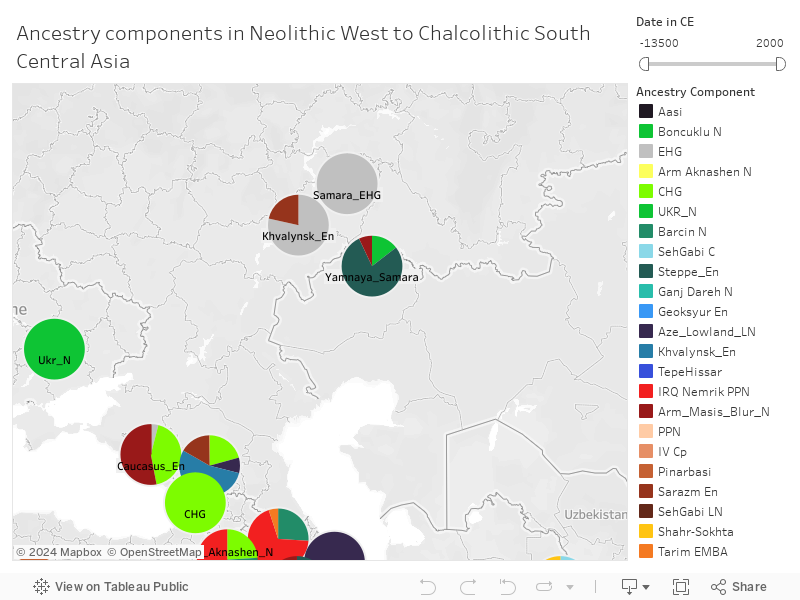
Map of ancestry distribution in West to SC Asia during the Neolithic


All the relevant populations from the early neolithic to chalcolithic are represented here. Most up to date map of population movements in the neolithic age, including the latest neolithic samples from Lazaridis et al 2022. All results have been arrived at using rigorous qpAdm rotating models.

If alternate model exists, I have noted them and will be visible once you hover on a label.

To pan the map, click the play button on the map and then and select the + button or Cross which enables the Pan cursor. Map can then be panned in all 4 directions. Pinch in/out to zoom. There is also a date filter.

Latitude/longitude of some labels might not be accurate. Co-ordinates of some labels have been shifted a bit so that there is less overlap between labels close to each other in location (eg. Seh_Gabi_LN, Seh_Gabi_C, Ganj_Dareh, Hajji_Firuz cluster; Arm_Masis_N, Arm_Aknashen, Aze_Lowlands cluster; Geoksyur & Gonur cluster; Boncuklu & Pinarbasi)


Wednesday, August 31, 2022

Armenia vs NW Iran - Two different short stories

 The Armenian Data from the new papers


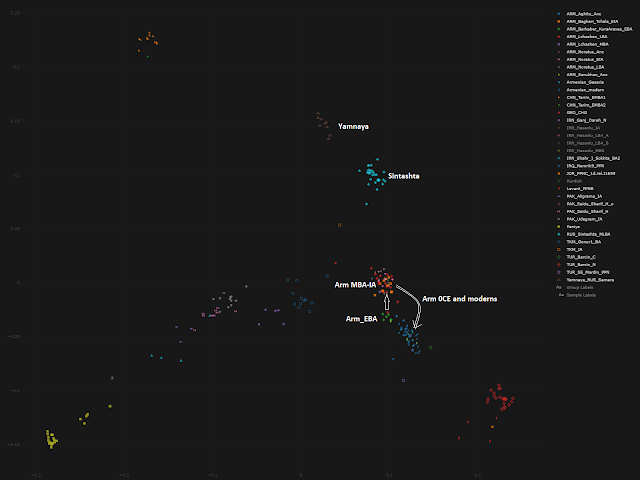
1. Some EHG ancestry from north of caucasus is seen at Areni Cave, 4200BCE.

2. EHG dilutes by the time of Kura Araxes 3600-2000BCE, Arm_EBA (green below).

3. Arm_MBA/LBA/IA cluster clearly shifts towards steppe, with lots of R1b & I2 Y hg. According to Lazaridis et al, this explains the Armenian language branch. For now I will accept this conclusion as it makes sense, and explains the different language of NW Iran.

4. Post IA, intense mixing with more southwestern populations (but not NW Iran) so much so that all steppe autosomal ancestry gets diluted.


Armenia PCA
PCA - Ancient & Modern Armenia

Friday, August 26, 2022

The Southern Arc paper and it's data upends the Steppe Theory in multiple ways


Hasanlu Indra chariot


Lazaridis, Iosif, et al. “The Genetic History of the Southern Arc: A Bridge between West Asia and Europe.” Science, vol. 377, no. 6609, 2022, https://doi.org/10.1126/science.abm4247.


This is a recently published paper ('the paper', 'this paper') with many new samples from what the authors call 'The Southern Arc'. The authors define it as 'a region centred on the large Anatolian peninsula (Turkey), including in the west (in Europe) the Balkans and the Aegean, and in the south and east, Cyprus, Mesopotamia, the Levant, Armenia, Azerbaijan, and Iran.'

The main conclusion of this paper which upends one part of the Steppe theory is that West Asia is now considered to be the homeland of the first Indo-European speakers, and the steppe to be only a secondary homeland. From the paper:

Thursday, August 18, 2022

A Relook at the Rakhigarhi ancestor I6113


In my previous post, I analyzed the so-called 'Indus Periphery' samples from the data published in Narasimhan et al 2019. 

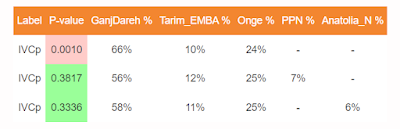
My conclusion was that the IVCp samples can be best modeled distally as 

Ganj_Dareh + Ancient North Eurasian (Tarim_Basin or West Siberian HG) + Onge + Levant_PPN or Anatolian Farmer.

IVC periphery models

In this post, I shall do an in depth analysis of the genome of the lone Rakhigarhi sample (Id: I6113, female) dated to around 2000 BCE, published in Shinde et al 2019. 

Burial picture of Rakhigarhi woman I6113
Picture of I6113 burial, Rakhigarhi. From Shinde et al 2019