Showing posts with label steppe. Show all posts

Monday, November 28, 2022

Mitanni at Hasanlu - Did they have Sintashta ancestry or not?

I want to make a quick post on a new article by Nezih Seven. You can find it here.

A Genetic Analysis of Historical Population Movements Around The Zagros Mountains


He analyzed the NW Iranian samples from the 'Southern Arc' paper and reached some interesting conclusions.

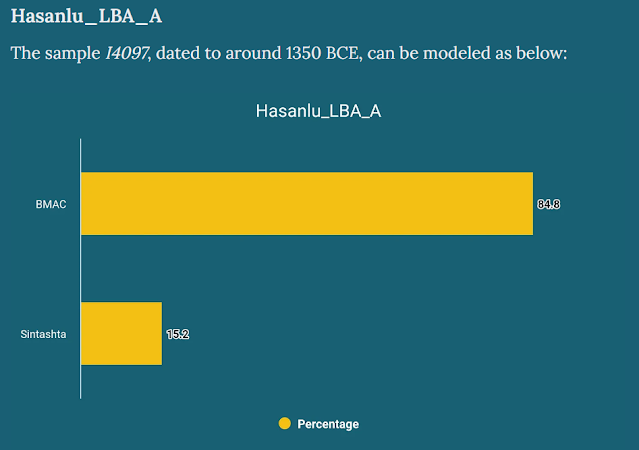
Nezih model hasanlu_lba 85% bmac + 15% sintashta
Model for Hasanlu_LBA_A by Nezih


The p-value of the above model is ~0.20 (therefore passing as p>0.05). His qpAdm output file can be seen here. 

Saturday, November 5, 2022

Ancestry trends of 150+ groups from the Indian subcontinent


In this article, I will lay out general ancestry trends of 150+ groups from the Indian subcontinent. And try to make it make sense to a lay audience.

Before I present the data table, there are some important caveats:

1. The purpose of the table is to concurrently compare the ancestry trends for 100+ groups of the Indian subcontinent. If the chosen sources are incorrect, they will be incorrect for all the groups but will still allow us to compare ancestry % across groups and make some conclusions. The fit (distance %) is not too relevant, and the distances of some groups will indeed be bad (>3%). However, that does not take away from our purpose of finding broad trends within the data.

Friday, October 14, 2022

R1a Explained

M780 r1a distribution


Y Haplogroups - A Primer


Y Chromosome haplogroup is a defined set of mutations in the (non-recombinant) portion of the DNA from male specific Y-chromosome. Y-Chr is passed down from father to son along with all the mutations that have been accumulated till that point. All the male descendants of a man will share the mutations in the Y-Chr of that man, plus all the additional mutations that have been collected in the generations between that man and the descendant on his specific male ancestral lineage chain. This feature helps us in identifying the most recent common paternal ancestor of a group of men and is a great tool for population geneticists. Do note that the same set of additional mutations cannot be created in two different men at the same time, the probability of that happening randomly is 0.

mtDNA haplogroups are mutations found in the mitochondrial DNA. Unlike autosomal chromosomes and Y chromosomes, mtDNA is found outside the cell nucleus. mtDNA is passed down from mother to children only, and therefore is informative only of the maternal lineage of a person. 

In this article, we will discuss Y haplogroups which can only inform us of the paternal ancestry of males.


Wednesday, September 28, 2022

Exploring the sources of the 'Southern ancestry' in the Steppe


The proximal source of the southern (IranN/CHG) ancestry in the Eneolithic Steppe as well as Yamnaya populations has been a mystery. Chintalapati et al 2022 infer that the admixture between Eastern European Hunter-Gatherers and Iran Neolithic ancestry occurred between 4400-4000BCE, using the DATES algorithm developed by Moorjani Lab.

In this post, powered with newly published samples as well as better tools than before, I will attempt to decipher the true sources of these populations.

Disclaimer: The analysis presented below is based on the currently available published samples from the Pontic Caspian Steppe. The samples from the Middle Don region (Allentoft et al 2022 preprint) are unavailable, and this analysis will be updated once those samples become available.

Sunday, August 14, 2022

Update: IVC & Swat Valley Genetics, Bonus - Kashmiri Pandit Ancestry

SECTION A: THE INDUS PERIPHERY SAMPLES


In the Narasimhan et al 2019 paper, 13 outlier samples were published - 10 from the Iranian site of Shahr-i-Sokhta (abbrv. SiS, various dates 3100-2000 BCE) and 3 from the Bactria Margiana Archaeological Complex (abbrv. BMAC) site of Gonur (2400-2000 BCE). These samples showed an elevated ancestry component found in the Onge Andamanese and modern Indians, which was not found in the main samples from SiS and BMAC. Based on this, the hypothesis was made that these people were migrants from one or more sites of the Indus Valley Civilization (abbrv. IVC) and were labeled as 'Indus Periphery Samples'.

Various Site Locations


Sunday, June 19, 2022

Marija Gimbutas's Kurgan Hypothesis rejected by Harvard


The Genetic History of the Southern Arc: A Bridge between West Asia & Europe

Below are some excerpts from the notes of a talk which will be delivered by Dr David Reich at an Israeli university in July 2022.

Our comprehensive sampling shows that Anatolia received hardly any genetic input from Europe or the Eurasian steppe from the Chalcolithic to the Iron Age; this contrasts with Southeastern Europe and Armenia that were impacted by major gene flow from Yamnaya steppe pastoralists.

The impermeability of Anatolia to exogenous migration contrasts with our finding that the Yamnaya had two distinct gene flows, both from West Asia, suggesting that the Indo-Anatolian language family originated in the eastern wing of the Southern Arc and that the steppe served only as a secondary staging area of Indo-European language dispersal. 

Here, Dr Reich confirms what I have already said before - That the Anatolian branch of the IE language family has its origin in Armenia and has nothing to do with Steppes. I believe this is the first time that Harvard will officially debar Steppefrom being a PIE homeland contender. 

Read my post - The Armenian Origin of the Anatolian branch of IE language family

Friday, May 6, 2022

New 7300 year old samples from the Middle Don region in Europe & the oldest sample yet from SC Asia


New Preprint: 

Population Genomics of Stone Age Eurasia. bioRxiv. Published online 2022. doi:10.1101/2022.05.04.490594


They found some new cool samples from 5300 bce. These are samples from Middle Don region with CHG ancestry. These should be the ancestors of the Khvalynsk samples who show no IranN/IndiaN as per my modeling. 

From the preprint:


Interestingly, two herein reported ~7,300-year-old imputed genomes from the Middle Don River region in the Pontic-Caspian steppe (Golubaya Krinitsa, NEO113 & NEO212) derive ~20-30% of their ancestry from a source cluster of hunter-gatherers from the Caucasus (Caucasus_13000BP_10000BP) (Fig. 3). Additional lower coverage (non imputed) genomes from the same site project in the same PCA space (Fig. 1D), shifted away from the European hunter-gatherer cline towards Iran and the Caucasus. Our results thus document genetic contact between populations from the Caucasus and the Steppe region as early as 7,300 years ago, providing documentation of continuous admixture prior to the advent of later nomadic Steppe cultures, in contrast to recent hypotheses, and also further to the west than previously reported.

We demonstrate that this “steppe” ancestry (Steppe_5000BP_4300BP) can be modelled as a mixture of ~65% ancestry related to herein reported hunter-gatherer genomes from the Middle Don River region (MiddleDon_7500BP) and ~35% ancestry related to hunter-gatherers from Caucasus (Caucasus_13000BP_10000BP) (Extended Data Fig. 4). Thus, Middle Don hunter-gatherers, who already carry ancestry related to Caucasus hunter-gatherers (Fig. 2), serve as a hitherto unknown proximal source for the majority ancestry contribution into Yamnaya genomes.


Now this 35% CHG/IranN which came in later, this should contain the IndiaN/IranN that I have written about at length in previous posts. 

Let me get my hands on the geno files, I should have a lot of fun working with these samples.

UPDATE:

The paper has 3 new samples from the neolithic Western Iranian site of Tepe Guran dated to around 7000BCE. Should be similar to the Ganj Dareh samples. The male sample is J2a.

Most importantly, they have a 4600 BCE sample from the south Turkmenistan site of  Monjukli-Depe.

Y-HG is L1a. The paper says this

"The Neolithic individual from Turkmenistan (~6,500 BP) clusters close to Neolithic Iranians."

So I think we will finally have a sample with the IndiaN ancestry rather than IranN. IranN is the western version, IndiaN being the eastern one. This ancestry gets diluted due to later influx from West Asia as seen in the later AnatoliaN heavy Geoksyur, Anau and Namazga samples.


Sunday, April 10, 2022

New ancient samples from Xinjiang may be a source for modern Ror and Burusho people

Kumar V, Wang W, Zhang J, et al. Bronze and Iron Age population movements underlie Xinjiang population history. Science. 2022;376(6588):62-69. doi:10.1126/science.abk1534

New mammoth paper containing 201 ancient samples from Xinjiang got published recently. Although I do not have access to the main paper yet, I did go through the supplement file and excel data which has most of the technical information about the samples. 

An in depth analysis of all the samples is out of the scope of this post, I will just leave a few generic thoughts about them here.

1. Early bronze age samples (pre 2000 Bce) have ancestry from Afanasievo, Tarim Basin and minor BMAC.

2. Late bronze age samples between 1500-1000 Bce are mostly similar to Sintashta_MLBA with minor addition of other ancestries.

3. For Iron age samples, in general they lie on a cline between Sintashta/Andronovo and east asian ancestry from Mongolia Slab grave culture. With some samples closer to Andronovo/Sintashta and other samples heavy on the east Asian ancestry.

4. All these Iron Age samples have additional ancestry from either BMAC, Afanasievo, Tarim Basin or Swat (SPGT), or all of them. In short, the samples are all over the place. 

5. None of the samples are confirmed archaeologically to be Tocharian speakers, so in my mind all 3 external ancestries - Afanasievo, Andronovo & BMAC could be a source for Tocharian. I prefer Andronovo as the Tocharian source, with BMAC ancestry providing Bactrian & Sogdian loanwords to Tocharian, but that's just a hypothesis.

6. The SPGT like ancestry from the Indian subcontinent almost definitely provided the Sanskrit loanwords, Buddhist culture and Brahmi script to Xinjiang in the iron age.

7. Bronze age male samples are mostly R1b+, possibly related to Afanasievo, with few Q1+ samples. 

8. 3 males samples from the LBA, 1 is R1a-Z2124+ (from andronovo), another is supposedly R1a-Z280+ (European) and 3rd one belongs to Q. Suggests increased andronovo related influence, which is also seen autosomally.

9. Among the male IA samples, there are many Q1+, many J2+, J1+ and central/east asia specific R1b-PH155 samples. Amongst the R1a samples, most if not all are of the Sintashta/andronovo kind, ie Z2124+ (R1a1a1b2a2+). One of the samples is of the Indian subclade R1a-Y3+ (R1a1a1b2a1+) and possibly even L657+. Given that most of Indian subcontinent R1a is L657+ (>80%) whereas most of andronovo related samples are Z2124+ (> 90%), andronovo does not seem to be a direct source of the L657+ Y hg in the Indian subcontinent.

10. Basic 2D PCA of the Xinjiang samples below. 3D PCA will present these complex ancestries more accurately. Most of the samples fall roughly between Sintashta and Mongolia_slabgrave, with additional ancestries from BMAC, SPGT, Afanasievo and Tarim_EMBA.
Xinjiang PCA


Saturday, March 5, 2022

The Armenian Origin of the Anatolian branch of IE language family

 The Anatolian Language Family

Source: Petra Goedegebuure | Anatolians on the Move: From Kurgans to Kanesh - Youtube (2)

Friday, January 7, 2022

Steppe-->Brahmin? Final evidence against Harvard's claim

I received a reply from Harvard's Dr. David Reich to the mail I had sent (check previous post comments).

Hi Ashish,


The Z-scores are formal tests for model fit – appropriately calibrated by a block jackknife – and the tail of large Z-scores are simply reflecting the reality of model failure.


What the analyses are showing is that the “Indian Cline” is in fact best modeled as a two-dimensional cloud not a one-dimensional gradient: a mixture of three source populations that cannot be simplified to a mixture of two source populations as we had done in previous modeling for example in Reich et al. Nature 2019.


As such, what our enrichment analyses are showing is simply that the groups of traditionally priestly status tend to be enriched for the Steppe-related source population after controlling for the proportions from the other two.

           Yours, David 


I will address these points in this analysis post. This will be final evidence to disprove the confident Steppe--->Brahmin causality claim made in the study.

Monday, January 3, 2022

Scratching my head! - Pt 2 - Major statistical analysis gap in Narasimhan paper undermines steppe->Brahmin theory

In a previous post, I had critiqued Narasimhan et al 2019 for the inference that steppe ancestry is significantly related to modern Indian Brahmin groups, and hence provides evidence that this steppe ancestry is causal to the Indo Aryan languages.
Nevertheless, the fact that traditional custodians of liturgy in Sanskrit (Brahmins) tend to have more Steppe ancestry than is predicted by a simple ASI-ANI mixture model provides an an independent line of evidence—beyond the distinctive ancestry profile shared between South Asia and Bronze Eastern Europe mirroring the shared features of Indo-Iranian and Balto- Slavic languages (58)—for a Bronze Age Steppe the origin for South Asia’s Indo-European languages.
I gave 3 main reasons why this reasoning and analysis was faulty.

1. Correlation is not causation, Brahmin steppe can be enriched by way of intermarriage with steppe rich brides. It may not have anything to do with the steppe causing the formation of brahmin jAtis.

Thursday, December 30, 2021

Steppe ancestry entered modern Indian Populations post 900 BCE

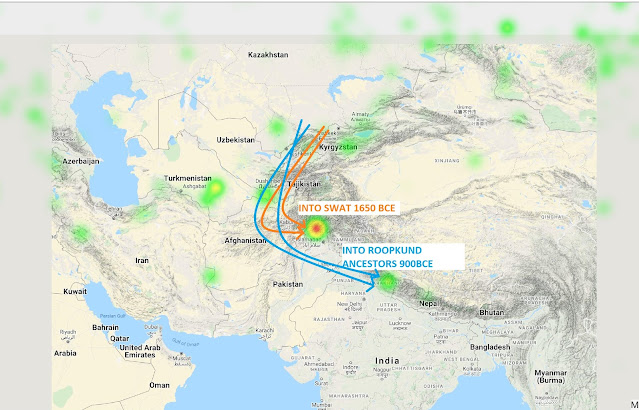
Steppe movement into Indian subcontinent - 1650BCE and 900BCE


In this post, I analyze the date of steppe admixture with local ancestry in Swat Valley Iron age samples (avg 910 BCE) and RoopkundA (avg 850 CE) samples from Uttarakhand, India. These are the only 2 sets of good quality ancient DNA samples from the Indian subcontinent, and therefore extremely important to study the genetic changes in the subcontinent. 

 In one of my earlier posts, I analyzed all 23 RoopkundA samples and show that in that set of 13 male samples, the steppe component is not correlated with Y-HG R1a1a, instead, it is correlated with Y-hg J2. 

Saturday, December 25, 2021

Sneak Peek: No steppe ancestry in Kashmir in 1300 BCE sample?

Since the 2019 Narasimhan et al paper on Swat Valley, Pakistan samples was published, one of the key questions which remained was — When did the steppe ancestry seen in modern Indians and Pakistanis enter mainland India? 

Location and details of burzahom site
Burzahom Site: Location and few pictures of the site.

Sure, the Swat valley samples from 1200–800 BCE show steppe ancestry, but when did it enter what is now modern Pakistan? The papers claims that this happened between 1800–1500 BCE, however ancient human samples till 1500 BCE in neighbouring Bactria Margiana Archaeological Complex (BMAC) show very little evidence of steppe people having traversed there. Crossing BMAC is a must to get from Steppe to Pakistan, so the question remained. 

We may have the answer through preliminary results obtained by one of the top Indian researchers in the field of population genetics, Dr. Niraj Rai. In a conference 3 weeks ago posted on Youtube, he let slip one of his unpublished findings — That there is no steppe autosomal ancestry to be found in north India till 1300 BCE, although he refrained from stating the site explicitly. Upon going through his talk, I think the only plausible sample he is talking about is from the site of Burzahom, near Srinagar, Kashmir. We shall see if my educated guess was correct.


When did the steppe ancestry reach mainland India? Or was it localized to other regions than Kashmir? Question remains open.

Monday, November 22, 2021

Open Thread - View on Bitcoin/cryptos?

So, Bitcoin 100k or 10k? Any other cryptos to consider? Which other samples do you want me to explore with qpAdm/qpgraph?


R-L657 poll results so far

Lets keep the votes coming :)

Where did R-L657 Originate
 
pollcode.com free polls

Saturday, November 20, 2021

Scratching my head! - Criticism of Narsimhan VM et al 2019 - Pt 1

In this post, I will start getting my thoughts about the seminal SC Asian paper organized in written form. I have had these stored in my head for 2 years. The data in the paper is absolutely fantastic, and we get the first aDna from South Asia ie Swat valley. But there are so many conclusions and data analysis choices made by the authors that left me scratching my head, so much so that this post got delayed because I just have so much to say but don't know where to begin.

Saturday, November 13, 2021

Are Bactrian (BMAC) horses not horses?

Librado, P., Khan, N., Fages, A. et al. The origins and spread of domestic horses from the Western Eurasian steppes. Nature 598, 634–640 (2021). https://doi.org/10.1038/s41586-021-04018-9

This paper was published in October 2021. The following is the abstract:
Domestication of horses fundamentally transformed long-range mobility and warfare. However, modern domesticated breeds do not descend from the earliest domestic horse lineage associated with archaeological evidence of bridling, milking and corralling at Botai, Central Asia around 3500 BC. Other longstanding candidate regions for horse domestication, such as Iberia and Anatolia, have also recently been challenged. Thus, the genetic, geographic and temporal origins of modern domestic horses have remained unknown. Here we pinpoint the Western Eurasian steppes, especially the lower Volga-Don region, as the homeland of modern domestic horses. Furthermore, we map the population changes accompanying domestication from 273 ancient horse genomes. This reveals that modern domestic horses ultimately replaced almost all other local populations as they expanded rapidly across Eurasia from about 2000 BC, synchronously with equestrian material culture, including Sintashta spoke-wheeled chariots. We find that equestrianism involved strong selection for critical locomotor and behavioural adaptations at the GSDMC and ZFPM1 genes. Our results reject the commonly held association between horseback riding and the massive expansion of Yamnaya steppe pastoralists into Europe around 3000 BC driving the spread of Indo-European languages. This contrasts with the scenario in Asia where Indo-Iranian languages, chariots and horses spread together, following the early second millennium BC Sintashta culture

I have a serious problem with the emphasized part, and the emphasis is mine. So I exchanged mails with the authors. They are pasted below. Thoughts in the comments will be appreciated.