Showing posts with label bmac. Show all posts

Wednesday, August 31, 2022

Armenia vs NW Iran - Two different short stories

 The Armenian Data from the new papers


1. Some EHG ancestry from north of caucasus is seen at Areni Cave, 4200BCE.

2. EHG dilutes by the time of Kura Araxes 3600-2000BCE, Arm_EBA (green below).

3. Arm_MBA/LBA/IA cluster clearly shifts towards steppe, with lots of R1b & I2 Y hg. According to Lazaridis et al, this explains the Armenian language branch. For now I will accept this conclusion as it makes sense, and explains the different language of NW Iran.

4. Post IA, intense mixing with more southwestern populations (but not NW Iran) so much so that all steppe autosomal ancestry gets diluted.
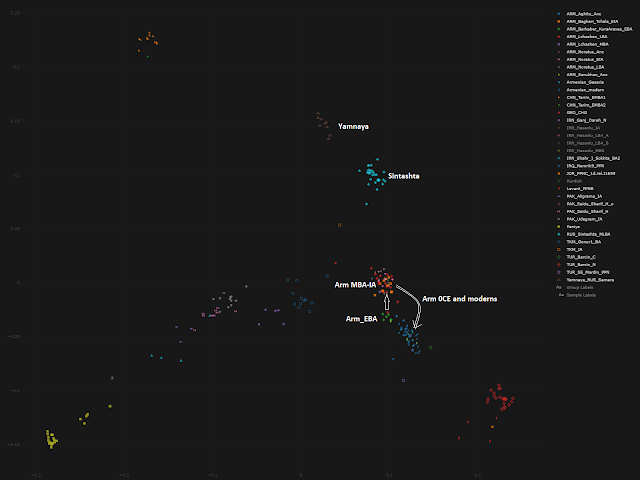

Armenia PCA
PCA - Ancient & Modern Armenia

Sunday, August 14, 2022

Update: IVC & Swat Valley Genetics, Bonus - Kashmiri Pandit Ancestry

SECTION A: THE INDUS PERIPHERY SAMPLES


In the Narasimhan et al 2019 paper, 13 outlier samples were published - 10 from the Iranian site of Shahr-i-Sokhta (abbrv. SiS, various dates 3100-2000 BCE) and 3 from the Bactria Margiana Archaeological Complex (abbrv. BMAC) site of Gonur (2400-2000 BCE). These samples showed an elevated ancestry component found in the Onge Andamanese and modern Indians, which was not found in the main samples from SiS and BMAC. Based on this, the hypothesis was made that these people were migrants from one or more sites of the Indus Valley Civilization (abbrv. IVC) and were labeled as 'Indus Periphery Samples'.

Various Site Locations


Thursday, December 30, 2021

Steppe ancestry entered modern Indian Populations post 900 BCE

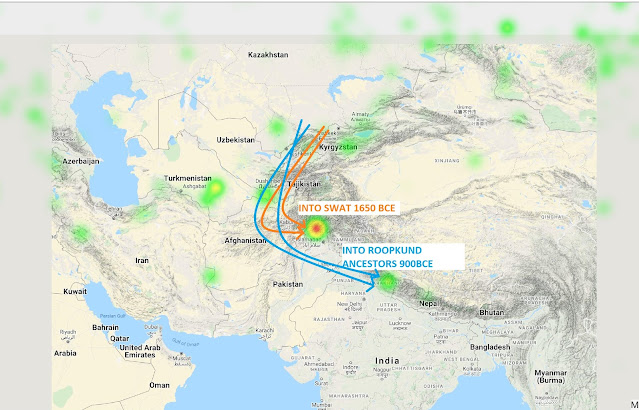
Steppe movement into Indian subcontinent - 1650BCE and 900BCE


In this post, I analyze the date of steppe admixture with local ancestry in Swat Valley Iron age samples (avg 910 BCE) and RoopkundA (avg 850 CE) samples from Uttarakhand, India. These are the only 2 sets of good quality ancient DNA samples from the Indian subcontinent, and therefore extremely important to study the genetic changes in the subcontinent. 

 In one of my earlier posts, I analyzed all 23 RoopkundA samples and show that in that set of 13 male samples, the steppe component is not correlated with Y-HG R1a1a, instead, it is correlated with Y-hg J2. 

Monday, December 20, 2021

R1a L657 in Roopkund lake, Uttarakhand from 800CE, but no Steppe

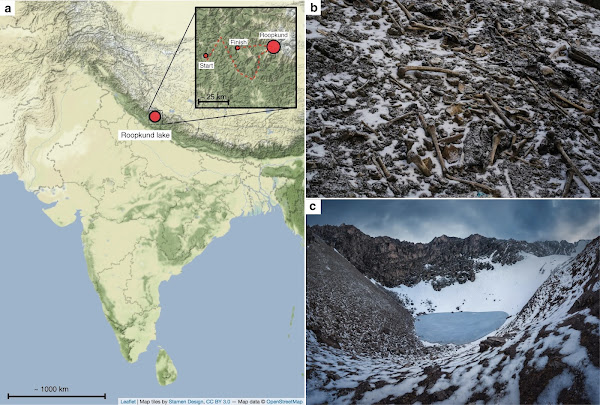
In 2019, a paper1 was published with the analysis of the remains of 38 individuals whose bones were found in Roopkund lake, Uttarakhand at an altitude of 5000m above sea level. 

Roopkund lake bones, Uttarakhand, India
Context of Roopkund Lake. a Map showing the location of Roopkund Lake. The approximate route of the Nanda Devi Raj Jat pilgrimage relative to Roopkund Lake is shown in the inset. b Image of disarticulated skeletal elements scattered around the Roopkund Lake site. Photo by Himadri Sinha Roy. c Image of Roopkund Lake and surrounding mountains. Photo by Atish Waghwase

Saturday, November 13, 2021

Are Bactrian (BMAC) horses not horses?

Librado, P., Khan, N., Fages, A. et al. The origins and spread of domestic horses from the Western Eurasian steppes. Nature 598, 634–640 (2021). https://doi.org/10.1038/s41586-021-04018-9

This paper was published in October 2021. The following is the abstract:
Domestication of horses fundamentally transformed long-range mobility and warfare. However, modern domesticated breeds do not descend from the earliest domestic horse lineage associated with archaeological evidence of bridling, milking and corralling at Botai, Central Asia around 3500 BC. Other longstanding candidate regions for horse domestication, such as Iberia and Anatolia, have also recently been challenged. Thus, the genetic, geographic and temporal origins of modern domestic horses have remained unknown. Here we pinpoint the Western Eurasian steppes, especially the lower Volga-Don region, as the homeland of modern domestic horses. Furthermore, we map the population changes accompanying domestication from 273 ancient horse genomes. This reveals that modern domestic horses ultimately replaced almost all other local populations as they expanded rapidly across Eurasia from about 2000 BC, synchronously with equestrian material culture, including Sintashta spoke-wheeled chariots. We find that equestrianism involved strong selection for critical locomotor and behavioural adaptations at the GSDMC and ZFPM1 genes. Our results reject the commonly held association between horseback riding and the massive expansion of Yamnaya steppe pastoralists into Europe around 3000 BC driving the spread of Indo-European languages. This contrasts with the scenario in Asia where Indo-Iranian languages, chariots and horses spread together, following the early second millennium BC Sintashta culture

I have a serious problem with the emphasized part, and the emphasis is mine. So I exchanged mails with the authors. They are pasted below. Thoughts in the comments will be appreciated.